What is the AI Shelf, and why does it fit only three brands?
By Bjorn Vandemeulebroucke · author of Become the Answer
I'm Bjorn Vandemeulebroucke, managing partner of a Word of Mouth Agency and author of Become the Answer. For over twenty years my work has been getting real people to recommend brands. Now that AI does the recommending, I measure and improve how brands show up in its answers.
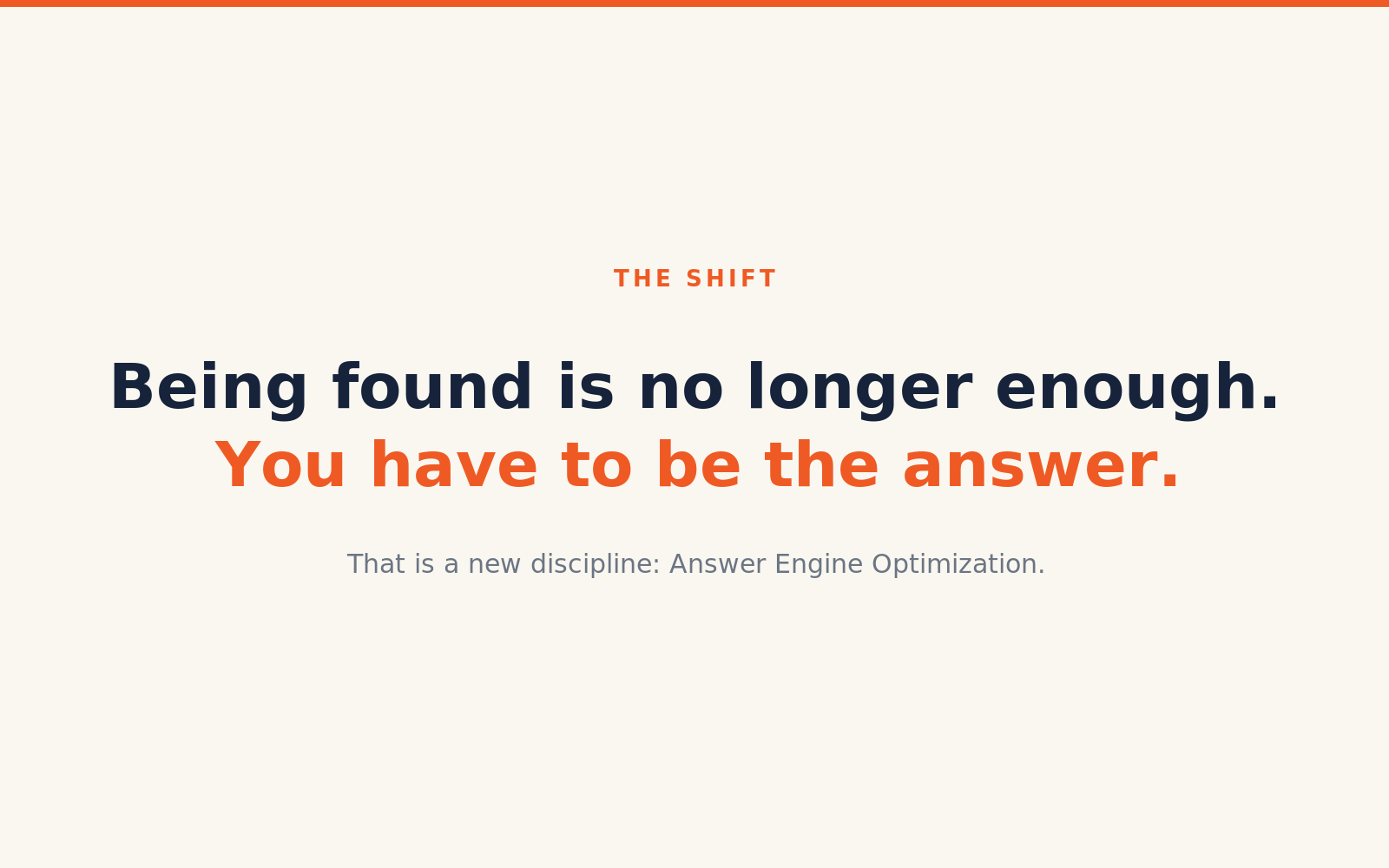
Winner takes most, no page two: your signature concept.
The AI Shelf is the short list of brands an AI names when it answers a category question: often five or six, sometimes just three. The rest of the market is not ranked lower; it is simply absent. Like the supermarket shelf before it, space is limited and position is everything.
Every era of commerce has had a shelf. In the store it was physical: the eye-level space you fought trade buyers to win, where a few brands got a facing and the rest sat on the bottom row. Then came the digital shelf: the search results page, the marketplace listing, where you competed for a rank instead of a row.
The AI Shelf is the next one, and it is the narrowest yet. Ask an assistant what to buy and it does not hand you twenty options to sort. It gives you a conclusion: a handful of brands, with a reason for each. Often five or six. Frequently three. That is the whole shelf.
Why so few? Because an answer is not a list. When a machine speaks in one voice, it has to be useful, and a useful recommendation is short. Naming twenty brands is not an answer, it is the problem the person asked the AI to solve for them. So the model compresses to the few it can defend, and everyone else falls off the edge of the sentence.
This is what makes the AI Shelf different from every shelf before it. On the digital shelf, ranking tenth still meant being found by someone who scrolled. In an answer, there is no scrolling and no page two. Being named fourth is identical to not existing. The economics are winner takes most: a few brands capture almost all the consideration, and the gap between being on the shelf and off it is total.
Which raises the only question that matters: what decides who earns a seat? Not who ranked highest yesterday. The AI Shelf is won by the brands a machine can read clearly, trust through others, and identify without confusion, and by how often they already show up in the answer, their share of it.
The old goal was to climb the page. The new one is to make the shelf. There are only three seats.
How many brands actually make the AI Shelf?
Often five or six, sometimes just three. Those brands take the whole shelf; everyone else is simply absent, with no ranked position to fall back on the way a lower search ranking would still be found.
- System shift
Related concepts
Want to know where your own brand stands in AI answers?
More from AEO Foundations
The shift
The buyer stopped researching.
Now they just ask.
The decision moves inside a single AI conversation you'll never see.
Has AI changed how people decide what to buy?
The buyer stopped researching a list; they ask, and act on the answer.
- Consumer shift
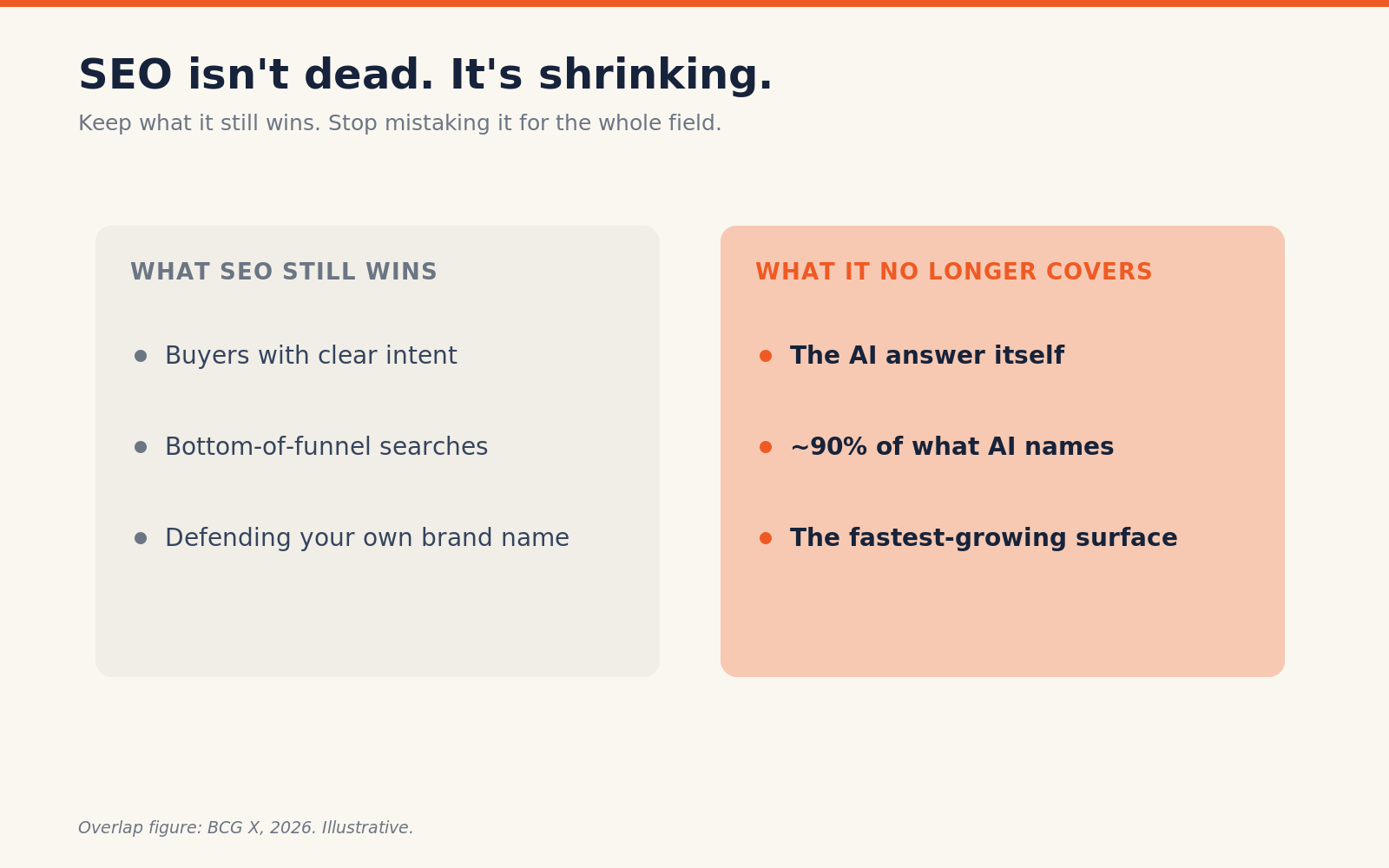
Is SEO dead, or just shrinking?
The honest answer: search isn't dead, but AI answers and search overlap by only 8 to 12% (BCG X).
- System shift
The funnel
The funnel didn't disappear.
It collapsed into one moment.
And most of that moment is dark to your analytics.
What happened to the marketing funnel in the age of AI?
The journey collapses into one recommendation moment.
- Consumer shift